Showing posts with label WNYC Note to Self. Show all posts

Monday, March 13, 2017

Your Phone is a Slot Machine Purposely Designed to Be Addictive

This video on the Time Well Spent site nicely explains
how apps are designed to be addictive.

In his TED Talk, How Better Tech Could Protect Us From Distraction and an essay, Tristan Harris explains that apps on your phone are a like a slot machine, designed to be addictive. He certainly has the background and inside experience to be able to state such a thing, as a former Google Design Ethicist and student at the Stanford Persuasive Technology lab (yes, there is such a place "looking for back doors in people's minds to influence their behavior"). The fact that phones are addictive is not news, but the fact that a former designer is not only openly explaining how tech companies are working to make things even more addictive than they are already and some are working to encourage an alternative solution is. I really admire this and appreciate his work.

This isn't the first time I have heard and blogged about Tristan. I first wrote about him two years ago (see Techcognition in an Attention Economy) after hearing him on WNYC's Note to Self podcast, one of my favorites. Host Manoush Zomorodi interviewed Tristan again last week about addictive apps and his new company, Time Well Spent. The episode, Will You Do a Snapchat Streak with Me? is worth hearing. I listened with great interest after seeing so many kids addicted to Snapchat. (With my own kids, we don't allow Snapchat until age 16, and often wish we hadn't ever allowed it!) A few main points which Tristan spoke about include:
  • 40 people at three companies are shaping how billions of people behave.
  • Recently the Netflix CEO said its biggest competitors are YouTube, Google, and sleep.
  • On Snapchat's Streaks: Snapchat's goal to is to hook kids and make it a habit (vs. an alternative like Duolingo, where users set usage goals to learning Spanish). 
  • No one is malicious, but technology isn't neutral. It has an intelligent engine in it fine tuned to make you use it more.
I especially found his description of phones as slot machines enlightening. In an essay on his website, Tristan asks: 
If you’re an app, how do you keep people hooked? Turn yourself into a slot machine. One major reason why is the #1 psychological ingredient in slot machines: intermittent variable rewards (he links to Wikipedia for more on this). The average person checks their phone 150 times a day. Why do we do this? Are we making 150 conscious choices? ... here’s the unfortunate truth — several billion people have a slot machine their pocket:
When we pull our phone out of our pocket, we’re playing a slot machine to see what notifications we got. 
When we pull to refresh our email, we’re playing a slot machine to see what new email we got. 
When we swipe down our finger to scroll the Instagram feed, we’re playing a slot machine to see what photo comes next. 
When we swipe faces left/right on dating apps like Tinder, we’re playing a slot machine to see if we got a match. 
When we tap the # of red notifications, we’re playing a slot machine to what’s underneath.
I'm struck by this analogy and concerned how we are giving our kids slot machines, getting them hooked into this cycle so early. So what can we do about it?
"Imagine a future where technology is 
built on our values, not our screen time."

Tristan explains that thousands of engineers are working to keep your attention. If they were to stop fighting the war for your time, they will lose money. So the only solutions to this are either regulation or a demand by consumers for something different. In his TED Talk, Tristan points out that McDonald's didn't offer salads to consumers until they demanded it. So, too, must we demand that technology be designed to use our time differently. I love the phrase at the end of the Panda Dancing video on their site linked above, "Imagine a future where technology is built on our values, not our screen time." That sounds great, and one we should start demanding!

Monday, June 20, 2016

Single Tasking to Combat Self-Induced Distraction and Infomania

Image Source
I frequently have written about something I first learned about on the Note to Self podcast, such as the Attention Economy, JOMO, and Crystal. Back in January, Note to Self issued a challenge for listeners combating Infomania and I participated.  Recently they revisited the topic with an Infomagical Bootcamp and it was a great refresher. I encourage you to listen to it (20 minutes is all it will take). Here are my highlights:

  • Multitasking is actually switching many tasks rapidly rather than doing more than one thing at once; not really new information, but important to understand. Switching attention uses glucose and is tiring, as well as increases stress. Scientists have determined that it takes 23 minutes and 15 seconds after an interruption to get refocused. Yikes!
     
  • There are external caused interruptions (such as a new email ding or incoming text message) and internally instigated interruptions (checking Facebook or surfing the web without being prompted). Scientists have observed that interruptions are "self perpetuating", meaning that if you have had a hectic hour of external interruptions, you are likely to frequently self-interrupt your work and thoughts the next hour even when not prompted to do so externally. We are making things worse for ourselves!
     
  • Research shows that the more urbanized you are, the more likely you are to be a "digital junkie" who spends more time consuming information and talking about it with others. However, only half the information we take in daily even gets stored and used in the future.
     
  • One solution: single tasking. Make lists and prioritize these to-do lists. Get things out of your mind that don't need your attention at that moment which would be a distraction. Our brain can only hold four items at a time anyway.
     
  • Another tip I found beneficial- don't let the environment dictate what you do. For example, starting your day off by sitting at your computer to answer the most recent emails allows those items to dictate what you are focusing on vs. spending time deeper in thought on a more important task or project from the previous day. 

Personally, I have found the Things program great for my lists and to-dos. I have also found it beneficial to take control of my phone and its apps by turning off almost all notifications, badges, and alerts. I believe it's important to reflect on our use of technology, which I've called Techcognition, as well as help our kids (who can't imagine life any differently) learn to do this. Single tasking is a skill I can help my kids learn and try to practice myself.  I hope you will, too!

Related Posts:


Monday, March 21, 2016

86+ Day Facebook Fast: You're either busy living or busy dying.

Christmas was 86 days ago. So was the last time I posted to Facebook. I was never a frequent poster in the first place, but I did look at what others posted almost daily. Not only have I not posted for 86 days, but I've also not looked at what everyone else has been updating. 

Facebook offers us the unique opportunity to connect with family and friends, many of whom we haven't seen in a long time. However, although I do enjoy seeing what my friends and family are up to, I wish there was some hierarchy of news and posts which would allow me to see only the most important updates in their lives when I log in. If there were a cap in the amount of content a person could post to a social network, I'd join it. I'd like to view things closer to the importance level of events shared in annual Christmas letters sent by snail mail in the past than the situation I found myself in before starting my fast: sifting through hundreds of posts, including check-ins from restaurants and pictures of daily events that wouldn't normally even make a verbal recap of the day. All this was in an effort to keep tabs on important events in the lives of my friends and family. 

I suppose this sounds selfish or like I don't care, but what I really wish for is a realistic balance. As I've written about in the past, I have been monitoring my techcognition: the amount of time I spend using technology, time I am distracted by it, and time I'm not mentally present with those around me due to looking at news feeds, sports scores, social networks, texts, and emails. Last year I began to realize just how much time I was spending looking a Facebook and in many cases, a lot of trivial information from people whom I wasn't super close to and/or hadn't seen for years, sometimes decades. Facebook had become a time drain for me, and fed into FOMO.  

Image Source
Without completely blocking the news updates from someone, I don't know of a way to narrow this amount down and not miss something really important. I can't envision a company like Facebook wanting to create something that wouldn't be viewed as frequently or for as much time, so I doubt this will happen, but maybe some sort of grassroots social network will evolve soon. Until then, I've opted to just stay out of it. Facebook kind of reminds me of a prison where you are just spending time. This in turn makes me think of one of my favorite films, Shawshank Redemption, when character Andy Dufresne said to fellow inmate Red: 
"Life comes down to a simple choice: You're either busy living or busy dying."
I can honestly say I don't miss Facebook. I may end up checking it a few times a year. But as far as daily or even weekly log ins, I'm going to spend more time living with my family and friends in person. And I'm going to help my kids see the benefits of living this way to. My daughter tells me it's a social faux pas to post to Instagram more than once a week, so maybe our kids are learning this balance already. Less FOMO and more JOMO. 

If you haven't seen Prince EA's "Can We Auto Correct Humanity" video above, please make time for it. Check out the past episodes of Infomania from one of my favorite podcasts, Note to Self, too. I made a couple of brief appearances on those episodes related to this very topic.

Related posts: 

Monday, January 25, 2016

Five Ways to Raise Digitally Balanced JOMO (Joy of Missing Out) Kids in a FOMO (Fear of Missing Out) World

This weekend I took one of my daughters to an exciting high school girls' basketball game, watched three of my kids play in their own basketball games, went both rollerskating and ice skating with my family, went for a run with a neighbor, went to church, took a couple long hikes in the woods with the dog, and more. I took a few pictures and some videos, but didn't post anything on social media. Had I not written about it here, no one would outside my family would have known. I'm OK with that. And I hope to help my kids understand that this is OK, too.

My surprising personal results from the FOMO quiz, despite
answering most questions with "Not at All" or "Slightly True"
Over the past few years I have been decreasing the frequency of both my own posts as well as how often I look at the post of others. During that time, I've read more articles about both FOMO (Fear of Missing Out) and more recently learned about JOMO (Joy of Missing Out) which have helped me think about how I spend my time and what I share with whom. Recently in another intriguing and thought-provoking Note to Self podcast, Manoush Zomorodi interviewed the creator Caterina Fake, originator of the term FOMO along with Anil Dash, the creator of the term JOMO. I found the conversation fascinating, and could relate personally to much of what they were saying about how and why people use social media, as well as the joy that can be found in not being distracted by trivial information and news. 

Last year as part of my New Year's resolutions, I set a goal to decrease digital distractions, nocializing and FOMO by turning off as many notifications as possible on my devices. I wanted to take control of how often I checked social media tools like Facebook and Twitter as well as email, weather alerts, sport scores, and more. It has been great. A year later, I am certainly not "cured" but definitely less addicted. Making the effort to decide when to open these apps versus allowing them to interrupt and push alerts at me has made a huge difference. I would encourage you to do the same if you haven't already.

I have also been reflecting on how I can help my own children. I think there is a need for us as adults who remember life before social media to help our children understand that not everything needs to be documented and posted. We can help them learn that it is OK not knowing and seeing what others are doing, and you can find freedom, meaning, and even joy in living life without posting about the experience. So, what can we do to help raise digitally balanced JOMO kids in today's FOMO world?  
Source: Bizarro Comics
  1. Model healthy, balanced use. Closely examine our own habits and lives to make sure that we are modeling for children what a healthy balance and use of technology is. In the past I have used the word techcognition to describe a one's self awareness of how technology is used. We need to pay attention to how often we are on our own devices, especially around our own children who are watching us and learning from the model we set. Decrease digital distractions, nocializing and FOMO by turning off as many notifications as possible on your devices.
     
  2. Be where your feet are, as one of my colleagues says. Don't look at your screen when you're with your kids, spouse, or family. Try it. When you do something together, don't post about it. Experience and enjoy life together with them without needing to post that you did this, modeling that a post (boast?) isn't necessary.
     
  3. Limit entertainment screen time, whether it is Netflix, video games, or social media. At our house, we have set up entertainment screen time limits of about 30-60 minutes a day. We don't have screens on during meals, don't leave the TV on, and don't have the latest video game systems. When our kids have had their entertainment screen time for the day, we encourage other activities (a board game, LEGOS, ping pong, outdoors). We also use Curbi to filter our children's smartphones and keep tabs on usage, sparking conversations (next tip).
     
  4. Have frequent conversations about FOMO and JOMO with our children. If we don't discuss this with them, I'm not sure they will ever learn about it. If we had grown up in this socially connected world, would it be possible to even realize the effects of FOMO? Can you even realize something can be different unless you are prompted by someone or experience another way of doing something? As parents, we can be this prompt for our children. Question them about what they post, what their friends post, how they feel about it, how much time the spend looking at posts, who they are connected with in their networks, and so on.
     
  5. Don't rush into social media. The official legal age to begin using social media tools like Instagram, Twitter, Facebook, and even Snapchat is 13. There is no need to rush into this. In our family, we have held to this and actually not allowed our children to begin using social media until they are in high school. At school we have some great tools that help prepare students to use public social media tools appropriately, such as Schoology, our private social learning management system. I do not see any reason to have kids begin using public social networks earlier than 13. Even at age 15, the only social media tool my daughter uses right now is Instagram. Sure, there were requests from her to begin earlier, but we knew she would have plenty of time in her life to use social media. We believe starting off slowly and forming good habits is important and will benefit her in the long run. 
Do you have other tips or ideas about this? Please let me know. 

Related posts: 

Monday, August 3, 2015

Techcognition in an Attention Economy

Sunset on Sawbill Lake in northern Minnesota, 
With three colleagues in Chicago for the
Schoology NEXT Conference.

Last week in less than a 24 hour period, I left the Schoology NEXT conference in downtown Chicago, flew home to Minneapolis, picked up my four kids and camping gear, and spent the next four days on Sawbill Lake in the Boundary Waters Canoe Area (BWCA). It was quite a transition from a tech conference in the city filled with skyscrapers and millions of people to the remote wilderness completely off the grid!

The BWCA is a national forest campground with over a million acres of lakes and forests in northern Minnesota on the Canadian border. There is no electricity, no running water, no motorized vehicles, and no roads. You travel by canoe and portage (carry) your gear over the land between them, which can be a short path or very, very long hike.

I believe this was my 17th year camping in the BWCA: my dad first took me in high school and then nine years ago we started bringing my own kids. Dad "retired" from these trips about four years ago and my college roommate joined me, helping with all the gear, cooking, and work. (My wife stays home and enjoys her time alone for a few days.) My kids started going when they were between the ages of three and five, and starting last year all four were old enough to join in the fun. The BWCA is a great place to spend time together, relax, swim, explore, observe nature, fish, play cards, read books, and disconnect.  I only used my phone as a camera.

I spent a lot of time thinking about being off the grid and aware that I was not connected or on a screen over those four days in the BWCA. You can really notice how much time you spend on a screen when it suddenly is not available. There wasn't any technology prompting me for my attention. There was no way to check in and see if I'd missed anything, either. 

The day after I returned home, I heard yet another fascinating (and timely) WNYC's Note to Self podcast episode entitled, The Attention Economy: What is Our Attention Actually Worth? In the episode, Manoush Zomorodi interviews Tristan Harris, a tech entrepreneur and design ethicist, who explains that some tech companies design for and get paid by the amount of time they can hold our attention in an app/program/device. Tristan wants to change this, and I hope he (we) can. He tells an interesting background story about the original designers of AirBnB, who originally measured the success of their service based on the positive time/value add that hosts and guests collectively reported about their stays and time together. Imagine focusing on a positive metric like that... versus bottom line profits based on how much time you can just grab someone's attention, taking them away from those around them, their thoughts, or just some down time! It's encouraging to hear that someone in Silicon Valley is thinking about designing technology to not demand more of our attention, and I hope other developers will adopt this way of thinking.

I believe that one of the essential skills we can teach our children as parents and educators is an awareness of how they spend their time with technology, how frequently, and the value of their interaction with it. As we see both them and ourselves being engaged and more dependent on screens and technology, it seems that it will be even more difficult in the future to recall life before this constant connection and screen presence. I wonder if future generations will even have times where they are just lost in their own thoughts in silence, or be with one another without technology present? I believe it is important to provide kids with experiences off the grid and/or away from technology so they know what it is like, as well as to frequently discuss an awareness of their use of and reliance on technology. 


Techcognition- an awareness and understanding
of one's own use of technology


Metacognition is the awareness and understanding of one's own thought processes. Perhaps now we need a term for the awareness and understanding of one's own use of technology. How about techcognition (or technognition)? I hope to help my own children and today's students with their techcognition skills. I want to help them learn balanced vs. addicted or distracted use. Technology is certainly here to stay. It is essential and beneficial in numerous ways. Helping today's kids learn to be cognizant of their interactions with it can only help prepare them for a future that will be even more connected than things are today.  

If you have never been to the BWCA, I highly recommend it. If you're fearful of what to pack or how to do it, there are plenty of outfitters and even guide services. I'd be happy to recommend something, just let me know. (Chicago is a great place to visit, too, but for different reasons.)

Related posts: 


Monday, June 1, 2015

Crystal Knows, Digital Footprints, and Personalized Learning

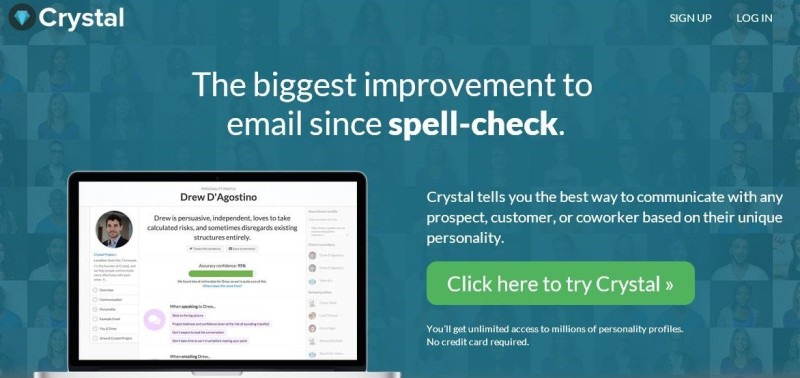
Last week on WNYC's Note to Self podcast (Formerly the New Tech City Podcast), host Manoush Zomorodi focused on a service called Crystal Knows, which I found pretty fascinating. Crystal Knows is an email "coach" that (who?) gives you suggestions on how to best respond to an individual based on their personality type. It determines this by scanning the Internet to look at public profiles and other online content. It then uses algorithms to determine that individual's personality type. This data is then shown to you as you are composing your email, and Crystal also coaches you as you write your response, letting you know whether or not your email is being written in the best possible way to have the biggest impact, make the sale, get your point across, etc.   

On the podcast, one of the individuals Manoush interviews mentions that a similar proprietary personal detection technology is used by some banks to determine whether or not to give an individual mortgage. Manoush observes that 
"every footprint we leave online is like a note in a dossier about us." 
This is yet another great example of why we all need to leave positive footprints online and think before we digitize anything.  When I speak to students about this, I always tell them to only post things their grandma would approve.  

Cyrstal Knows is using information it finds to automatically determine an individual's personality.  I'm sure it will only be a matter of time before there are other programs out that that will determine an individual's likely success in a college for admissions, employability for an HR department, or determine our medical and life insurance rates based on our profiles- where we eat, what our friends do, etc. Of course, all of this probably exists and is already in use, I just haven't heard of it yet!

They discuss how this sort of technology can be creepy to some, as well as whether or not an individual using Crystal Knows should be required to disclose this fact to a recipient. These are certainly intriguing questions to ponder... 

I'm optimistic that as more algorithms are created to categorize humans in all areas, we will better be able to personalize learning in education, too. The more a computer knows about an individual, the better it can target and tailor the instruction to each specific learner.  Already we have the seen the benefits of tutoring programs that can adjust the level of the content and questions to each individual learner.  I'm sure that programs like Crystal Knows can also be used to aid the method of instructional delivery to better know how to reach and encourage each student. It will be exciting to see the next tech thing in this area!